The Los Angeles Area Council #33 served Los Angeles and surrounding communities until its 2015 merger with the San Gabriel Valley Council. Its history continued the work of the Los Angeles Council and Los Angeles Metropolitan Area Council, whose earlier organization, volunteers and camping properties provided the foundation for its postwar growth.
The council became one of the largest in the United States. Its activities extended from neighborhood Cub Scout packs and Scout troops to waterfront instruction, mountain summer camps and wilderness expeditions. Supporting that work required a changing network of properties, partnerships and benefactors. Several familiar camp names survived moves, rebuilding projects or changes in program, making the council’s facilities an important part of understanding its history.
Growth into a Nationally Prominent Council
Contemporary newspapers document the size of Los Angeles Scouting before the great expansion of the postwar years. When Arthur A. Schuck was appointed Scout executive in May 1944, the San Pedro News Pilot described the organization as the country’s fifth-largest council, with approximately 16,000 Scouts in 540 troops and packs.1
Schuck’s appointment also connected Los Angeles with the BSA’s national leadership. In 1948, he became the organization’s third Chief Scout Executive, a position he held through 1960.2
By May 1951, a newspaper report identified Los Angeles as the nation’s fourth-largest council, with 44,000 members. That scale created an urgent need for additional camping opportunities. Former council president John K. Northrop had studied the camping holdings of the twenty largest councils and found Los Angeles comparatively short of land. Even after a major mountain acquisition, its approximately 1,400 camping acres remained below the reported average of 2,400 acres for those councils.3
Local Scouting also produced an activity that spread far beyond the council. On May 15, 1953, Cubmaster Don Murphy’s Pack 280C held the first Pinewood Derby in Manhattan Beach. The miniature wooden-car competition became one of Cub Scouting’s most recognizable traditions.4
The council’s public activities included conservation and community service. In June 1970, council president Dr. Robert J. Downey announced participation in the BSA’s forthcoming Project SOAR—Save Our American Resources. The national campaign called for conservation instruction, litter prevention and service projects during 1971.5
Early Camps and the Expanding Property Network
Some facilities associated with the Los Angeles Area Council originated under its predecessors. Camp Arthur Letts, in the Hollywood Hills, provided an accessible gathering and camping place close to the city. Its development included land donated by J. B. Lankershim in 1921 and buildings designed by architect Gordon Kaufmann. The camp combined sleeping accommodations, assembly space and swimming facilities, bringing substantial outdoor programming within reach of urban troops.6
Arthur Letts remained important after the war. Siwinis Lodge held its first annual dinner there in December 1947 and its first annual Pow Wow there the following year. These gatherings illustrate how a council camp could support leadership, fellowship and organization as well as overnight camping.7
Another early mountain camp carried several names. A published inventory identifies Big Pine, Siwinis and Pepperdine as successive names associated with the earlier camp near Jackson Lake. The council’s High Adventure Team history likewise describes Camp Siwinis becoming Camp Pepperdine following George Pepperdine’s support for additional campsites. This earlier location should be distinguished from the later Camp Pepperdine within the Lake Arrowhead reservation.8
The council’s broader camping history also includes Rio Hondo, Morningside, Sigler and Vaughn Scott. Historical inventories identify Morningside and Sigler as leased facilities and Thousand Pines as a Baptist camp used by Scouts. Earlier predecessor-council facilities included Radford and Seely. These distinctions matter: a place used regularly by council Scouts was not necessarily land owned by the council.9
Lake Arrowhead, Forest Lawn and Hubert Eaton
The council’s principal mountain reservation developed east of Lake Arrowhead, on land now known as Hubert Eaton Scout Reservation.
Its early growth combined gifts with purchases. The Los Angeles Turf Club presented 160 acres in 1949. In 1951, council president Walter H. Rolapp announced the acquisition of an adjoining 1,050 acres. Camping chairman Horace Hahn described plans for several camps capable of accommodating approximately 1,000 Scouts at a time. The property offered mountain terrain, access to Deep Creek and Sheep Creek, and extensive national forest boundaries.10
Known initially as the Lake Arrowhead Scout Camps, the reservation developed around multiple camps and specialized program areas. Its history includes Camp Big Horn, Camp Cedar, Camp Pitchess, Camp Pepperdine, Northrop Family Camp and the John Wayne Outpost. George Aunger, an early resident director, documented the reservation’s development in his 1971 history, High Adventure: The Story of the Lake Arrowhead Scout Camps.11
The changing names describe both the reservation as a whole and individual camps within it. Camp Big Horn later operated as Circle X Ranch at Big Horn, preserving a name associated with the council’s separate Santa Monica Mountains property. Cedar became known as Pitchess; later facilities included Camp Pollock. Those names should not be treated as a simple sequence of identical buildings, since rebuilding and changes in program altered the reservation over time.
A council map revised in 2010 shows the division of activities particularly clearly: Circle X Ranch at Big Horn served Boy Scout resident camping; Camp Pollock provided Cub Scout resident camping and a training center; Camp Pepperdine accommodated high adventure, Venturing and National Youth Leadership Training. The John Wayne Outpost offered another distinct camping area.12
The reservation became Forest Lawn Scout Reservation in 1992, according to the published camp-history inventory. Its later name, Hubert Eaton Scout Reservation, followed a $10 million AS&F Foundation gift announced in July 2017. That final renaming occurred under the successor Greater Los Angeles Area Council.13
Circle X Ranch and Firestone Scout Reservation
The original Circle X Ranch occupied the Santa Monica Mountains above Malibu. The National Park Service identifies the property as a former Scout camp, with access to Sandstone Peak and the surrounding mountain landscape.14
The council sold Circle X for $5.85 million in 1987, beginning its transition into public parkland.15
Firestone Scout Reservation, in Tonner Canyon near Brea and Diamond Bar, supplied a different kind of resource: extensive land for weekend camping, training and activities within reach of the metropolitan area.
A 1959 dedication report traced the search for this property to 1953 and its identification to November 1954. Leonard Firestone, the Chandler family and the Arnold Haskell Foundation supported the project, while John K. Northrop chaired development. The report described approximately 3,500 acres available for camping, about half then owned by the council, and reported 47,000 users during 1958.16
Firestone’s boundaries later contracted. In 2000, the City of Industry’s redevelopment agency purchased a substantial portion for $16.5 million. Conservation organizations challenged the transaction and proposed reservoir development, bringing the council’s property decisions into a wider debate about Tonner Canyon’s future.17
Cabrillo and Log Cabin
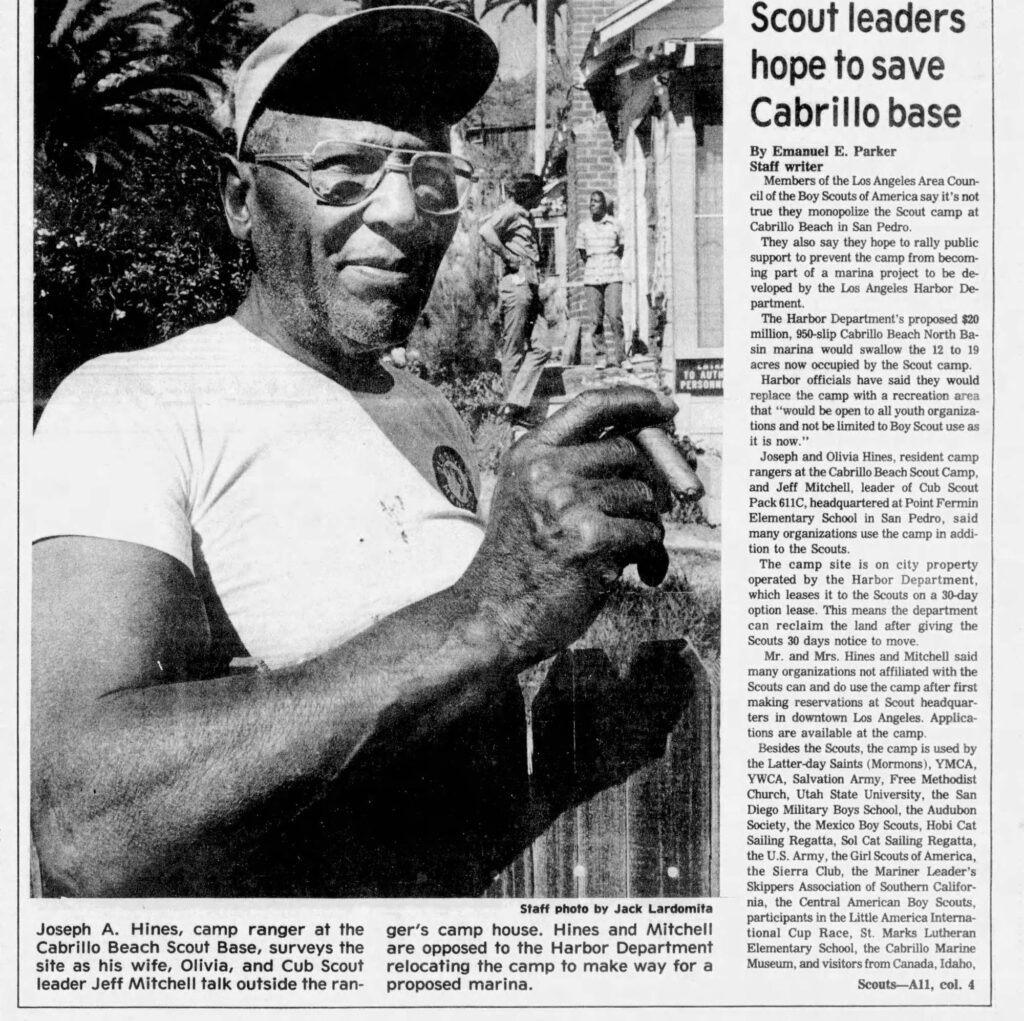
At the coast, the Cabrillo Beach Youth Waterfront Sports Park supported aquatic instruction and camping in San Pedro. Council waterfront activities began there in 1946, initially using tents, military Quonset huts and trailers under a Fort MacArthur lease.
A 1982 agreement with the Port of Los Angeles enabled construction of a larger youth center. The council raised more than $3.6 million, with major contributions from Steven Spielberg and the Amateur Athletic Foundation, now LA84. Mayor Tom Bradley dedicated the complex in 1987. Its facilities included a swimming pool, campground, boat house and the Spielberg Center, serving Scouts and other youth organizations.18
Farther from Los Angeles, Log Cabin Wilderness Camp provided access to the eastern Sierra near Lee Vining. The High Adventure Team’s chronology dates donation of the Log Cabin Mine property to 1970 and the camp’s opening to 1975. Later programs included High Country Gateway and Mountain Man experiences.19
Leadership, Rebuilding and the 2015 Merger
Camping also extended beyond developed properties. The council adopted the Silver Moccasins Trail Award in 1947, encouraging substantial backpacking journeys through the San Gabriel Mountains. Its Trails and Awards Committee, formed in 1963, became the High Adventure Team in 1973.20
Siwinis Lodge #252 supported this outdoor program through service and leadership. Chartered in April 1944, the lodge adopted the name of the council’s earlier summer camp. Its district chapters connected the council’s many communities with a common organization devoted to camping and service.21
Maintaining the council’s facilities demanded repeated investment and protection from wildfire. The October 2003 mountain fire destroyed more than fifty buildings at Forest Lawn Scout Reservation. As reconstruction progressed, the reservation faced another wildfire threat in 2007. Council president Robb Scoular credited retired Fire Chief Nobby Schnabel, Ranger Chris Sergief, and fire officers Eric Oldar and Mark Whitworth with protecting the rebuilt facilities during those fires.22
The reconstruction campaign ultimately raised more than $16 million, and the expanded reservation was rededicated on July 18, 2008. Together, the recovery from the 2003 destruction and the protection efforts during the 2007 fires represented a substantial commitment to preserving the council’s principal mountain camp.23
The council also renewed its urban facilities. Opened in 2008, the Cushman Watt Scout Center incorporated a half-acre outdoor activity area above a parking garage near Temple Street and Rampart Boulevard. Gifts totaling $4 million from John Cushman and Ray Watt helped fund a center intended to bring outdoor instruction directly to city youth.24
In 2015, the Los Angeles Area Council merged with the San Gabriel Valley Council to create the Greater Los Angeles Area Council #33. The merger combined two established organizations and their camping, training and volunteer traditions.25
The resulting council inherited a history that reached from neighborhood meeting places to coastal facilities, mountain reservations and Sierra wilderness camps. Those properties—and the volunteers, professional Scouters and donors who sustained them—remain central to the Los Angeles Area Council’s contribution to Southern California Scouting.

Council Pages
- Apache Council # 7 (1922 – 1934)
- Arrowhead Area Council # 48 # (1933 – 1972)
- Bakersfield Council # 30 (1919 – 1921)
- Balboa Canal Zone Council
- Boulder Dam Area Council # 328 (1944 – 2005)
- California Inland Empire Council # 45 (1973 – Present)
- Catalina Council # 11 (1922 – Present)
- Centinela Council # 708 (1927)
- Central Coast Counties Council # 25 (1922 – 1924)
- Cochise County Council # 8 (1922 – 1963)
- Copper Council # 9 (1962 – 1977)
- Coronado Council (1916 – 1917)
- Crescent Bay Council # 26 (1922 – 1972)
- Desert Pacific Council # 49 (1993 – 2004)
- Desert Trails Council # 29 (1959 – 1993)
- Glendale Council # 58 (1920 – 1922)
- Globe Council (1916 – 1919)
- Grand Canyon Council # 10 (1993 – Present)
- Grand Canyon Council # 12 (1944 – 1993)
- Grand Canyon Council # 9 (1922 – 1929)
- Grayback Council # 24 (1952 – 1974)
- Great Western Council # 51 (1972 – 1985)
- Greater Los Angeles Area Council # 33 (2015 – Present)
- Hemet-San Jacinto Valley Council # 28 (1923 – 1927)
- Imperial County Council # 29 (1922 – 1929)
- Imperial-Yuma Council # 29 (1929 – 1959)
- Kern County Council # 30 (1922 – 1965)
- Las Vegas Area Council # 328 (2005 – Present)
- Long Beach Council # 32
- Los Angeles Area Council # 33 (1945 – 2015)
- Los Angeles Council # 33 (1915 – 1934)
- Los Angeles Metro Area Council # 33 (1934 – 1945)
- Los Padres Council # 53 (1994 – Present)
- Maricopa County Council # 10 (1923 – 1924)
- Mission Council # 53 (1929 – 1994)
- North Orange Council # 37 (1965 – 1972)
- Northern Arizona Council # 12 (1929 – 1934)
- Northern Orange County Council # 37 (1944 – 1965)
- Old Baldy Council # 43 (1921 – 2006)
- Orange County Council # 39 (1920 – 1944, 1972 – Present)
- Orange Empire Council # 39 (1944 – 1972)
- Pasadena District Council # 40 (1919 – 1929)
- Pasadena-San Gabriel Valley Council # 40 (1929 – 1951)
- Phoenix Council # 10 (1921 – 1923)
- Pomona Council # 43 (1917 – 1921)
- Prescott Council # 12 (1915 – 1921)
- Redlands Area Council # 23 (1945 – 1952)
- Redlands Council # 24 (1919 – 1921)
- Riverside Council # 45 (1919 – 1920)
- Riverside County and Redlands Council # 45 (1944 – 1945)
- Riverside County Council # 45 (1920 – 1944, 1945 – 1972)
- Roosevelt Council # 10 (1924 – 1962)
- San Antonio District Council (1922 – 1934)
- San Bernardino District Council # 48 (1923 – 1933)
- San Bernardino Valley Council # 48 (1922 – 1923)
- San Diego Council # 49 (1916 – 1921)
- San Diego County Council # 49 (1914, 1917 – 1992)
- San Diego-Imperial Council # 49 (2004 – Present)
- San Fernando Valley Council # 50 (1923 – 1972)
- San Gabriel Valley Council # 40 (1951 – 2015)
- San Luis Obispo County Council # 56 (1933 – 1939)
- Santa Barbara Council # 53 (1919 – 1929)
- Santa Lucia Area Council # 56 (1939 – 1994)
- Southern Sierra Council # 30 (1965 – Present)
- Theodore Roosevelt Council # 10 (1962 – 1993)
- Three G Council # 9 (1943 – 1962)
- Tucson Council # 11 (1920 – 1922)
- Ventura County Council # 57 (1921 – Present)
- Verde Council # 715 (1925 – 1927)
- Verdugo Hills Council # 58 (1922 – Present)
- Western Los Angeles County Council # 51
- Yavapai & Mohave Counties Council # 12 (1924 – 1926)
- Yavapai District Council # 12 (1922 – 1924)
- Yavapai-Mohave Council # 12 (1926 – 1929)
- “New Scout Executive Named for L. A. Area,” San Pedro News Pilot, May 2, 1944, California Digital Newspaper Collection.
- Order of the Arrow, “Arthur Schuck,” biographical history.
- “Arrowhead Reservation to Accommodate 1000 Scouts,” Rolling Hills Herald, May 24, 1951, California Digital Newspaper Collection.
- Scout Life, “May 15 Is an Important Day in Scouting History,” May 15, 2013; Scouting, “The Founder and the Finder,” November–December 1999.
- “Boy Scouts Undertake SOAR,” Palos Verdes Peninsula News, June 17, 1970, California Digital Newspaper Collection.
- Mary Mallory, “Hollywood Heights—Los Angeles’ Forgotten J. B. Lankershim Monument,” The Daily Mirror, September 9, 2013.
- Tuku’ut Lodge, “Siwinis Lodge #252 History,” published February 4, 2018.
- Bob Sherman, “Collecting Camp Patches,” ISCA Journal, September 2018, pp. 16–17, online issue; Greater Los Angeles Area Council High Adventure Team, This Is Your High Adventure Team, historical section.
- Bob Sherman, “Collecting Camp Patches,” ISCA Journal, September 2018, pp. 16–17, online issue.
- “Arrowhead Reservation to Accommodate 1000 Scouts,” Rolling Hills Herald, May 24, 1951, California Digital Newspaper Collection.
- Area 4 History, “Hubert Eaton Scout Reservation,” and its reproduction of George Aunger’s 1971 camp history.
- Los Angeles Area Council, Forest Lawn Scout Reservation map, revised July 1, 2010, reproduced in the 2014 Scout Winter Camp packet.
- Bob Sherman, “Collecting Camp Patches,” ISCA Journal, September 2018, p. 16, online issue; Greater Los Angeles Area Council, announcement of the AS&F Foundation gift and Hubert Eaton naming, July 29, 2017.
- National Park Service, “Circle X Ranch,” Santa Monica Mountains National Recreation Area.
- Los Angeles Times, “Natural Legacy: Scouts’ Favorite Haunts Go Public at Circle X Ranch,” March 14, 1987.
- La Habra Star, April 22, 1959, report on the forthcoming Firestone dedication, California Digital Newspaper Collection.
- Los Angeles Business Journal, “Deals & Dealmakers,” December 17, 2000.
- Greater Los Angeles Scouting, “Cabrillo Beach Youth Center,” historical account of waterfront operations, the 1982 lease and 1987 dedication.
- Greater Los Angeles Area Council High Adventure Team, This Is Your High Adventure Team, historical chronology.
- Greater Los Angeles Area Council High Adventure Team, This Is Your High Adventure Team, historical section and chronology.
- Tuku’ut Lodge, “Siwinis Lodge #252 History,” February 4, 2018.
- Robb Scoular, “A Note from Your Council President,” Los Angeles Area Council, 2007–08 report, online reproduction, p. 6.
- Tom Fitt, “A Man Prepared,” Peninsula People, December 2008, reprinted in the Los Angeles Area Council report, online reproduction, p. 8.
- Los Angeles Business Journal, “Scouts Scale New Heights,” July 6, 2008.
- Greater Los Angeles Area Council High Adventure Team, This Is Your High Adventure Team, 2015 chronology entry.